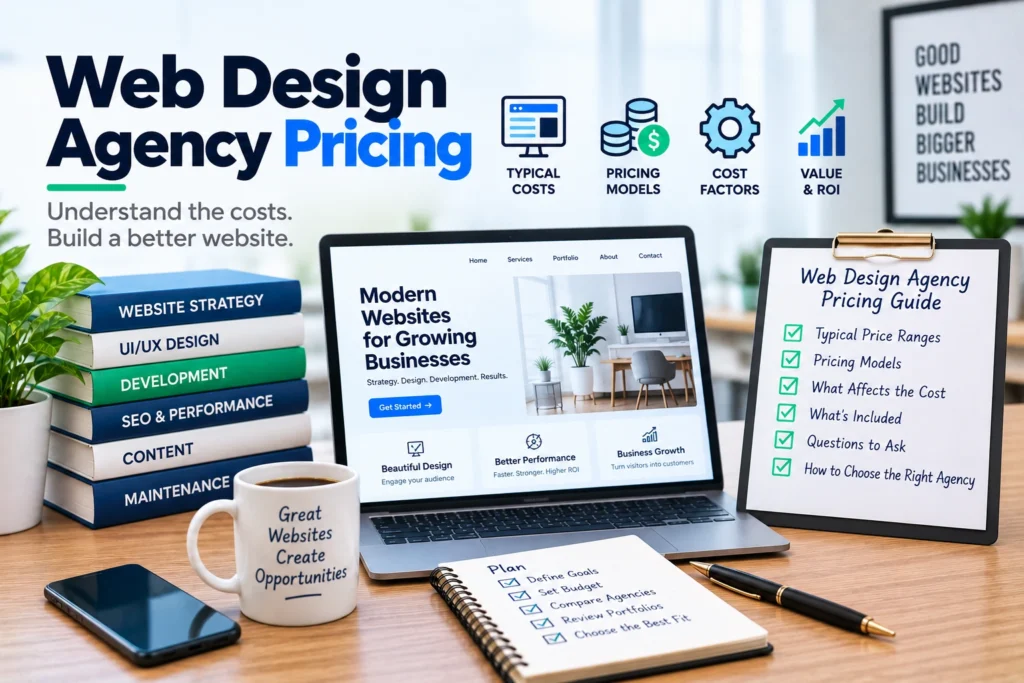
If you’re budgeting for web design services, one of the first questions is simply: what should this cost? Pricing in this category varies widely by provider, scope, and business size, so this guide pulls together the ranges reported across published 2027 industry pricing surveys and agency rate cards to give you a realistic starting point before you request quotes. We’ll cover how pricing models typically work, what providers actually charge, the factors that move the number up or down, and the questions to ask so you don’t get caught by hidden fees.
How Web Design Pricing Typically Works
Web design is most often priced as a project-based fee scoped to the size and complexity of the site, though ongoing design retainers and per-page or per-component pricing are also used.
What Web Design Typically Costs in 2027
- Industry pricing guides report an overall range of about $1,000 to $30,000+ for most business websites, with larger enterprise builds sometimes exceeding $100,000.
- By site size, reported ranges include roughly $1,000–$3,000 for 1–75 pages, $3,000–$6,000 for 75–150 pages, and $6,000–$10,000 for 150–250 pages.
- By business tier, reported ranges include about $6,500–$15,000 for a basic small-business site, $15,000–$50,000 for an intermediate mid-sized build, and $50,000–$100,000 for an advanced enterprise site.
- Component-level pricing commonly cited includes copywriting at $60–$300 per page, custom style/design work at $2,000–$15,000, ecommerce functionality at $5,000–$25,000, and database integration at $2,000–$25,000.
- Some full-service agencies price ongoing web design/development support as a monthly retainer starting around $8,000/month rather than a one-time project fee.
Note: the figures in this guide are drawn from published industry pricing surveys and agency rate cards current as of 2027, not from a single source. Actual quotes from any individual agency can vary from these ranges. Always request a written quote scoped to your specific project before budgeting.
Common Web Design Pricing Models Explained
Providers in this space generally price their services one of a few ways, and it’s worth understanding each before you start comparing quotes:
- Monthly retainer, a fixed recurring fee for an ongoing scope of work, which makes budgeting predictable but requires you to define the scope clearly upfront.
- Hourly billing, you pay for time actually worked, which suits narrowly defined or one-off projects better than open-ended ongoing programs.
- Project-based / flat fee: a single price for a clearly scoped deliverable, common for audits, one-time builds, or defined campaigns.
- Performance-based or percentage-based: fees tied to a variable like ad spend, leads generated, or revenue, which shifts some risk onto the provider but can also create misaligned incentives if not structured carefully.
None of these models is inherently better than the others, the right one depends on how predictable you need your costs to be and how well-defined your scope of work already is.
What Affects the Price
Page count and site complexity, whether the build includes custom functionality (ecommerce, membership areas, integrations), whether copywriting and photography are included or handled separately, and whether you’re hiring an agency versus a freelancer all significantly affect price.
Beyond those factors, also expect pricing to move based on how quickly you need results (rush timelines often cost more), whether you need multilingual or multi-market support, and whether the provider is based in a high-cost market versus offering offshore or nearshore delivery.
Hidden Costs to Watch For
Beyond the headline retainer or project fee, a few costs are easy to miss when comparing web design quotes:
- Onboarding or setup fees charged separately from the first month’s retainer.
- Software, tools, or platform licensing costs that aren’t included in the management fee.
- Charges for additional revision rounds, rush work, or scope changes mid-contract.
- Early termination or cancellation fees buried in the contract terms.
- Ad spend, media costs, or third-party platform fees that are separate from the agency’s management fee.
Ask each provider to walk through their full fee structure line by line before you sign, rather than assuming the headline number is the total cost. For more on evaluating a provider beyond price alone, see our How to Choose a Web Design Agency guide.
Is Web Design Worth the Investment?
Whether web design pays for itself depends on your starting point, your goals, and how well the engagement is scoped. For most businesses, the honest way to evaluate this isn’t the sticker price alone but the cost relative to the value of the outcome you’re trying to achieve: new customers, retained revenue, or time saved by not building the capability in-house. Before committing to a retainer, it’s worth asking any provider you’re considering how they’ll measure success and how long it typically takes to see a return, so you have a clear benchmark to hold the engagement against.
How to Get an Accurate Quote
Because pricing varies so much by scope and provider, the ranges above are a starting point, not a quote. To get an accurate number, request proposals from at least two or three providers for the exact same defined scope of work, ask each one to itemize what’s included versus billed as an add-on, and confirm whether the number quoted is a monthly retainer, a one-time project fee, or tied to a variable like ad spend or lead volume. For a curated list of web design providers to request quotes from, see our Best Web Design Agencies guide, and for guidance on evaluating providers beyond price, see How to Choose a Web Design Agency.
Frequently Asked Questions
Is a freelancer cheaper than a web design agency?
Often yes for straightforward sites, since freelancers typically carry lower overhead, but an agency can offer more capacity, project management, and a broader skill set (design, development, SEO, copywriting) under one roof.
What’s included in a typical web design quote?
This varies widely, so ask specifically whether the quote includes copywriting, stock or custom photography, SEO setup, mobile responsiveness, and a set number of revision rounds before comparing quotes.
Why do ecommerce sites cost more than brochure sites?
Ecommerce functionality (product catalogs, payment processing, inventory integration) adds significant development complexity compared to a static informational site, which is reflected in the higher reported price ranges above.
Are there hidden fees I should watch for?
Ask specifically about setup or onboarding fees, charges for extra revision rounds, fees for switching strategy mid-contract, and whether reporting and strategy calls are billed separately from the core deliverable. A written statement of work should spell out exactly what’s included.
Should I sign a long-term contract to get a lower rate?
A longer commitment sometimes comes with a modest discount, but it also reduces your flexibility if the engagement underperforms. Many buyers prefer a shorter initial term (three to six months) to evaluate fit before committing longer.